 Français
 English
WHAT IS LOAD CELL TEDS ?
For measuring systems containing large numbers of various types of sensors, the configuration and calibration of all these sensors involve a huge amount of work, which is not only time-consuming but also means that mistakes are more likely to be made.
Load cell ‘‘plug and play’’
One solution would be ‘‘plug and play’’ sensors which, once connected, would be automatically recognised and calibrated.
Thanks to the standard for a smart transducer interface (IEEE 1451.4), this is now possible.
This standard defines a format for each type of sensor (such as a load cell, an acceleration sensor, etc.) which not only includes general information, such as sensor type, model, etc., but also provides technical information, such as sensitivity, type of bridge, excitation voltage, etc.
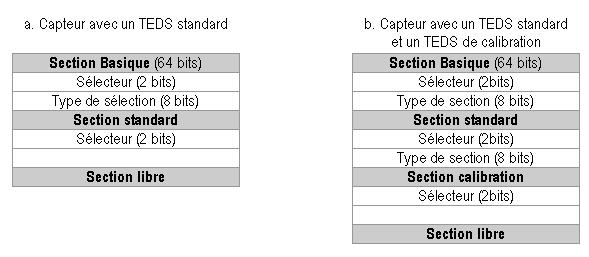
The standard defines a TEDS as consisting of several sections, each of which refers to information for characterising the load cell. Please see below the two formats that define the specific properties used by SENSY:
For load cells, we work in mixed mode, which involves adding a serial link to the analogue signal that enables access to the load cell's information, available on an EEPROM (Electrically Erasable Programmable Read-Only Memory).
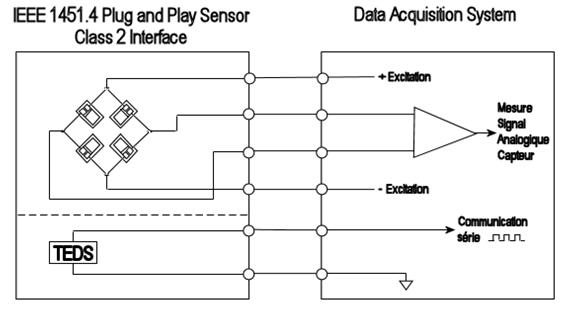
TEDS transducers
The transducers with this feature are called "TEDS transducers" (Transducer Electronic Data Sheet transducers).
For traditional non-TEDS transducers or for measurement systems that are not adapted to this technology, we also propose virtual TEDS. Here, the principle is identical except for the support on which the data is memorised. In the case of the virtual TEDS, none of the sensor datasheet is integrated into the sensor, but is in a downloadable file ".ted" available on our website. Thus, rather than having to configure your system by specifying all the sensors’ parameters manually, they are identified automatically.
The advantages of TEDS sensors
The advantages of TEDS sensors are multiple: saving time during their installation; less risk of errors; faster repairs; zone free (able to be read anywhere in the world) and accessible to the user, etc.
In addition to technical data-processing standards, we can add a calibration table to the memory module in TEDS transducers to correct the non-linearity of certain sensors automatically.